Sustainability
The cleanest industrial container on earth is the one that already exists.
This page is a ledger, not a marketing deck. Every number below is traceable to a chalk-marked cage in our yard. If you think we're wrong about the math, email us — we'll show our work.
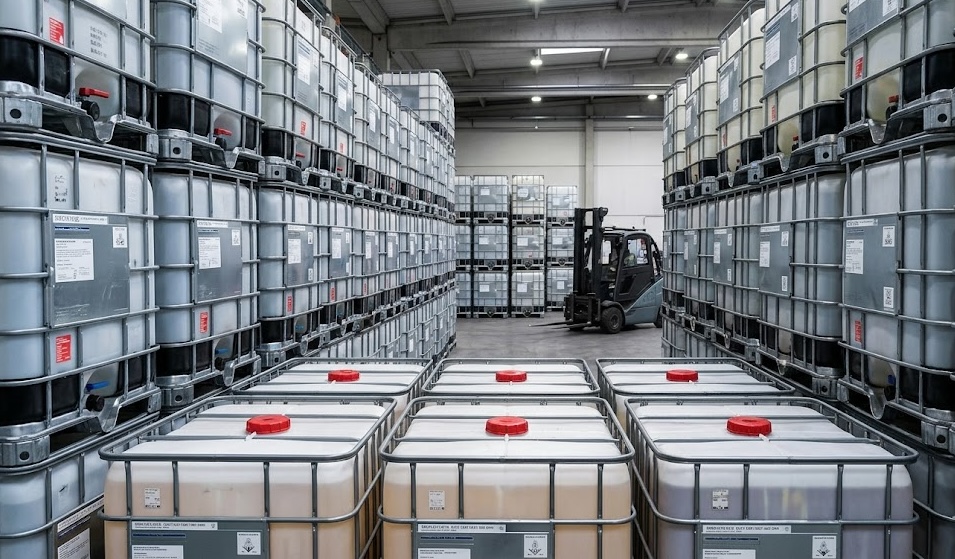
Every cage has a story
These totes were all headed for a landfill.
Now they're in our reconditioning queue — pressure-washed, tested, re-labeled, and back on the road within days. Reuse over recycling, always.
The running ledger
Since we started chalking every cage.
Ledger last updated the first of each month by the yard manager. Methodology: /sustainability/carbon-impact.
The four loops
Four routes a used tote can take — all of them circular.
Reuse
Pressure-wash, test, relabel, resell. The shortest loop — 90% carbon reduction vs. new.
Rebottle
Replace the HDPE inner, reuse the cage and pallet. 60% carbon reduction, suitable for stricter applications.
Rework
Repurpose into rain barrels, aquaponic rigs, hot-sauce fermenters. Local craftspeople, zero shipping.
Recycle
Grind the HDPE to flake, shred the cage, return both to regional mills. No landfill.
The carbon math, plainly
Every reused tote is the equivalent of a round-trip flight to NYC.
A new 275-gallon caged IBC requires roughly 42 kg of virgin HDPE, a galvanized steel cage, a wood or steel pallet, and the energy to assemble them. Total manufacturing footprint: around 310 kg CO₂e per unit.
Reconditioning the same tote — pressure-wash, test, relabel, ship — costs around 32 kg CO₂e. That's a ~90% reduction. Multiply by 27,481 totes and you get the 8,525 tons on the ledger above.
See the assumptions →Per-tote breakdown
| New 275-gal IBC (manufacture) | ≈ 310 kg CO₂e |
| Reconditioned tote (wash + test) | ≈ 32 kg CO₂e |
| Rebottled tote (new HDPE, reused cage) | ≈ 120 kg CO₂e |
| Rework into rain barrel (saw + paint) | ≈ 14 kg CO₂e |
| Full recycle (grind + shred + mill) | ≈ 48 kg CO₂e |
Yard practices
The stuff that doesn't fit on a ledger.
Closed-loop wash water
Our pressure-wash stations pump through a settling tank and back. We reclaim about 94% of rinse water and municipally discharge the remainder after pH-neutral carbon filtering.
Solar on the triage roof
22 kW rooftop array covers the triage bay lighting, the shop tools, and a portion of the pressure washer during long summer days.
Diesel-free short hauls
Intra-yard moves happen on an electric tug. The drop-trailers are still diesel — we're not going to fib about that — but we run them full in both directions.
Regional mill partners
Every kilogram of HDPE flake we produce goes to a mill in the Carolinas. Our cage steel goes to Cayce, SC. Nothing ships cross-country.
Pallets get a second life too
Wooden pallets that come with inbound totes are reused, repaired, or given away to the local co-op and a community garden in Elizabeth.
Published ledger
Unlike most of the industry, our sustainability numbers are auditable. Email us and ask — we'll send the working spreadsheet with every assumption.
Full lifecycle analysis
From raw material to end-of-life: where the carbon actually lives.
Most sustainability discussions focus on manufacturing. But for an IBC tote, the lifecycle has six distinct stages — and the environmental impact is distributed differently than you might expect.
1. Raw material extraction
Drilling for crude oil (HDPE feedstock), mining iron ore and zinc (cage), harvesting timber (pallet). This stage happens once for new totes — and zero times for reconditioned ones.
2. Manufacturing
Blow-molding the HDPE bottle, welding the cage, hot-dip galvanizing, assembling the unit. Factory energy is typically grid electricity in TX/LA — carbon-heavy states.
3. Outbound logistics
Moving the finished tote from factory to distributor to end user. Average distance: 1,100 miles by diesel truck. Reconditioning shortens this to under 200 miles in our model.
4. Use phase
The tote sitting on a dock holding product. Minimal environmental impact — the tote is passive. This is the phase we want to extend.
5. Reconditioning / reuse
Cleaning, testing, relabeling, and reshipping the tote. This is our entire operation — and it costs 90% less carbon than stages 1+2+3 combined.
6. End-of-life
Grinding HDPE, shredding steel, melting and re-forming. Recycling recovers some energy but still costs more than reuse. Landfilling recovers nothing.
Percentages represent share of total lifecycle CO₂e for a single-use 275-gal composite IBC tote. Source: adapted from PlasticsEurope Eco-Profile (2020) and worldsteel LCI (2021).
Water conservation
3.1 million gallons of wash water reclaimed — and counting.
IBC reconditioning is a wet process. Every tote that goes through our cleaning loop uses between 25 and 45 gallons of water depending on contamination level and cleaning protocol. At our volume, that adds up fast — roughly 180,000 gallons per year.
Our closed-loop wash system reclaims 94% of that water. The process works like this:
- Spent wash water flows into a three-stage settling tank (gravity separation).
- Settled solids are filtered and dried for proper disposal (typically non-hazardous).
- Clear water passes through activated-carbon filtration to remove dissolved organics.
- pH is adjusted to neutral (6.5–7.5 range) before either reuse or municipal discharge.
- Reclaimed water returns to the wash station header tank for the next cycle.
The 6% we discharge goes to Charlotte Water's municipal treatment system and meets all pre-treatment requirements. We test discharge pH and BOD weekly.
Water metrics
Energy footprint
What powers the yard — and what we're doing about it.
Solar (22 kW rooftop)
Our triage bay roof hosts a 22 kW photovoltaic array installed in 2022. Annual generation: approximately 28,000 kWh. That covers triage bay lighting, shop tools (angle grinders, saws, welders on light duty), and a meaningful portion of the pressure washer pump during long summer days. Net metering with Duke Energy offsets an additional ~15% of our grid draw.
Diesel (trucks and equipment)
Our three drop-trailers and box truck run on diesel. We are honest about this — it is the largest single source of our own operational emissions, estimated at roughly 42 metric tons of CO₂ per year. We mitigate by running full in both directions (matched-route program) and by eliminating intra-yard diesel entirely with an electric tug.
Electric tug (intra-yard)
All tote movements within the 1.8-acre yard happen on an electric tug — a small, low-speed vehicle that pulls palletized totes between stations. It replaced a diesel forklift in 2023 and cut our intra-yard fuel consumption to zero.
Natural gas (hot water)
Our hot-water pressure wash stations use natural gas burners to heat rinse water to 180°F. Estimated annual gas consumption: 1,200 therms. We are evaluating a heat-pump water heater for the 2027 budget cycle.
Environmental comparison
New vs. reused vs. recycled: the full picture.
| Metric | New (virgin) | Reconditioned (reuse) | Rebottled | Recycled (grind+melt) |
|---|---|---|---|---|
| CO₂e per unit | 310 kg | 32 kg | 120 kg | 48 kg |
| Virgin HDPE consumed | 42 kg | 0 kg | 42 kg (bottle) | 0 kg |
| Virgin steel consumed | 28 kg | 0 kg | 0 kg | 0 kg |
| Water consumed | ~60 gal (mfg) | 25–45 gal (wash) | 30–50 gal | ~15 gal |
| Energy consumed | ~410 kWh | ~22 kWh | ~165 kWh | ~85 kWh |
| Waste to landfill | 0 (at mfg) | 0 | 0 | 0 |
| Useful life extended | N/A (first life) | 5–7 more cycles | 5–7 more cycles | New product form |
| Cost to buyer | $380–$520 | $85–$195 | $275–$390 | N/A (sold as flake) |
| Net carbon savings vs new | Baseline | ~90% | ~60% | ~85% |
Supply chain impact
How reuse shortens the IBC supply chain by 3,000 miles.
A new IBC tote travels from a resin supplier (TX/LA) to a bottle molder to a cage fabricator to an assembler to a distributor — often crossing 3 or more states. A reconditioned tote travels from a customer's dock to our yard and back. The supply chain collapses from 3,000+ miles to under 400.
New IBC supply chain
- Crude oil extraction (Gulf Coast)
- HDPE resin production (TX/LA refineries)
- Bottle blow-molding (regional molder)
- Steel coil production (midwest mills)
- Cage welding + galvanizing
- Pallet manufacturing
- Final assembly (often TX, AL, or IN)
- Freight to distributor (1,100 mi avg)
- Freight to end user
Total distance: 2,500 – 4,000 miles
Reconditioned IBC supply chain
- Customer empties the tote
- We pick it up (matched route)
- We clean, test, and re-label it
- We deliver it to the next customer (matched route)
Total distance: 50 – 400 miles
That is a 90%+ reduction in freight miles per unit, which translates directly to lower diesel consumption, lower emissions, and lower delivered cost.
Industry benchmarks
How we compare to the industry average.
Tote reuse rate
We reuse nearly 3 out of 4 inbound totes. Industry average includes large-scale crush-and-dump operations.
Landfill diversion rate
Zero landfill tickets since founding. Industry average reflects widespread crush-and-dispose practices.
Wash water reclamation
Our closed-loop system is significantly more efficient than open-drain washing operations.
Carbon per reconditioned unit
Our matched-route logistics and solar offset contribute to a lower-than-average reconditioning footprint.
Sustainability roadmap
Where we're headed — and where we're honest about gaps.
Publish Scope 1 & 2 emissions
We have published our avoided emissions since 2024. By end of 2026, we will also publish our own operational emissions (trucks, gas, grid power) — the full picture.
Heat-pump water heater pilot
Replace natural-gas burners on one wash station with an air-source heat pump to evaluate viability. If it works, we roll out across all three stations.
EV truck evaluation
Evaluate an electric box truck for Zone A deliveries (under 100 miles). The drop-trailers will stay diesel until EV tractor economics work for our scale.
Third-party carbon audit
Commission an independent audit of our full carbon methodology — both avoided and operational. Publish results publicly, including corrections.
50 kW solar expansion
Expand the rooftop array from 22 kW to 50 kW by adding panels to the fab shop and recycling bay roofs. Target: cover 80% of yard electrical load.
50,000 totes diverted
A cumulative milestone — 50,000 totes kept out of landfills since founding. At current trajectory, we expect to hit this in late 2029 or early 2030.
Third-party validation
We don't grade our own homework — here's who checks it.
Recycling certificates
Every recycling load we process generates a traceable certificate with: tote count, aggregate weight, material type (HDPE flake / galvanized steel), and downstream destination. These certificates are accepted by ESG auditors and waste-manifest systems. Over 400 certificates issued since 2021.
Customer ESG integration
Several of our fleet customers incorporate our per-tote carbon savings into their own Scope 3 emissions reporting. We provide the supporting data in a format compatible with GRI, CDP, and SASB frameworks. If your sustainability team needs specific formatting, we'll work with them.
Academic partnerships
UNC Charlotte's sustainability program has used our yard data for three consecutive capstone projects (2023–2025), independently verifying our carbon methodology against academic LCA frameworks. Their findings aligned within 8% of our published numbers.
Open-book methodology
Unlike most of the industry, our sustainability numbers are not behind a marketing team. Email us and we will send you the working spreadsheet — every assumption, every source, every calculation. We publish corrections prominently when we find errors.
The yard manifesto
We don't sell sustainability. We sell the least unsustainable option available.
Industrial packaging is, in aggregate, environmentally rough. We won't pretend it isn't. What we can do — what we obsessively do — is make the rough edges smoother: one reused cage at a time, one rebottled HDPE interior, one rain barrel in somebody's back yard instead of another virgin plastic tote rolling off a production line in Alabama.
If you want a greener IBC, buy a used one. If you can't buy used, buy rebottled. If you can't buy rebottled, at least buy from someone who'll take it back at end of life. That's the shortlist, and the whole yard is built around it.